The Complete Porfingles ChroniclesBeing a personal histoy of Pewfell Porfingles, his extended family and friends. Pewfell’s family tree can be traced back four generations to the legendary wizard Elendor the Great, of whose great deeds we know little, as he could never be bothered to write them down. Almost nothing is known of Elendor’s background or origin, though some had said that he must have been descended from Fluka the Goddess of Luck, because he certainly was a jammy git. Likewise, the fate of Elendor is a mystery. Some say he battles still against the forces of evil in the lower planes; others reckon he is probably propping up a bar in some hedonistic city in a remote corner of the Urf. What is known is that Elendor left behind a son, who he named after himself, Elendor II. Elendor II was pushed into the adventuring profession and forced to follow in his father’s footsteps, which he was not happy about. The shadow of his father’s name always loomed over him and he was never able to live up to it. He eventually retired at the relatively young age (for a wizard) of 103, in order to raise his family and run a disreputable magic shop in Zorsk. There, on the southern coast of the Midworld sea, he lived out his days in a befuddled haze, hopelessly addicted to healing potion. He married an exotic dancer he met there, and had two children, the eldest being a daughter named Elena, and a son whom he belligerently named Elendor III. Elendor III’s mother fell under the influence of a Bedouin cleric and ran off into the great desert while her children were still small. Elena took on the responsibility of running the household, while her brother spent most of his time ignoring his father’s attempts to badger him into never becoming an adventurer.
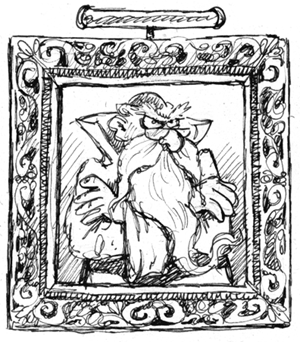
A striong family resemblance is apparent in these portraits that hang in Cawdor Castle.
Elendor III disliked his sister, loathed his father and hated the hot, dusty city of Zaresh. So, as soon as he was old enough, he left home to attend the remote, but prestigious, Stonestanding School of Sorcery in Northern Pendria (or southern Beouria, or western Vordath, depending on whichever province felt like claiming it at the time). At that time, Stonestanding was perched on a gravity-defying promontory that jutted off the western edge of the city of Spirekassle. The weather in that region is mostly cold, and damp - though summers are nice, winters are long and deep. Elendor III always told people he moved there for the climate. Elendor III was a good student and became an enthusiastic adventurer. He formed a band of valiant do-gooders and they made quite a name for themselves, adventuring in the wild lands of Vordath; long before that became the fashionable thing to do. Elendor III’s companions were: the great cleric Benson (and his twin brother Hedges); Gerard D’Wellard (the smirking cavalier), Miranda the Mighty (a warrior paladin from Prantem), Puff-Bellow (the doughty dwarf), and Elias (the elegant elf). Over the length of their careers they did much to bring peace and prosperity to that chaotic northern region, and their deeds were long sung of, especially by all the bards that they later employed with the mountains of loot they plundered.
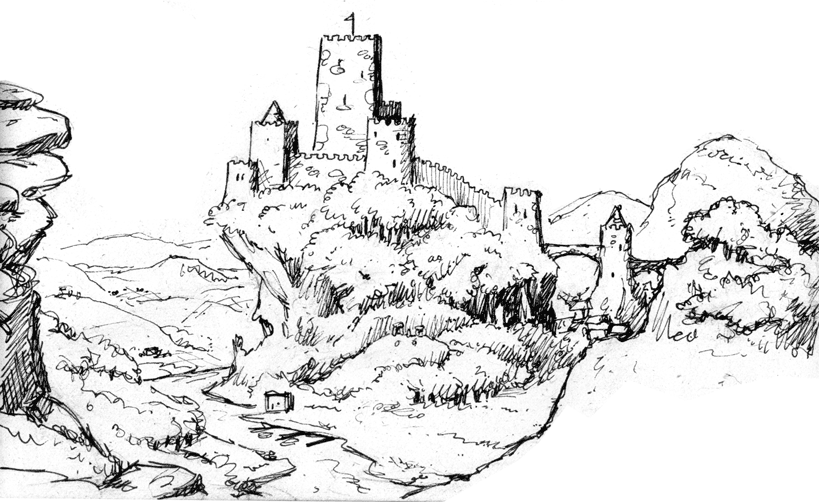
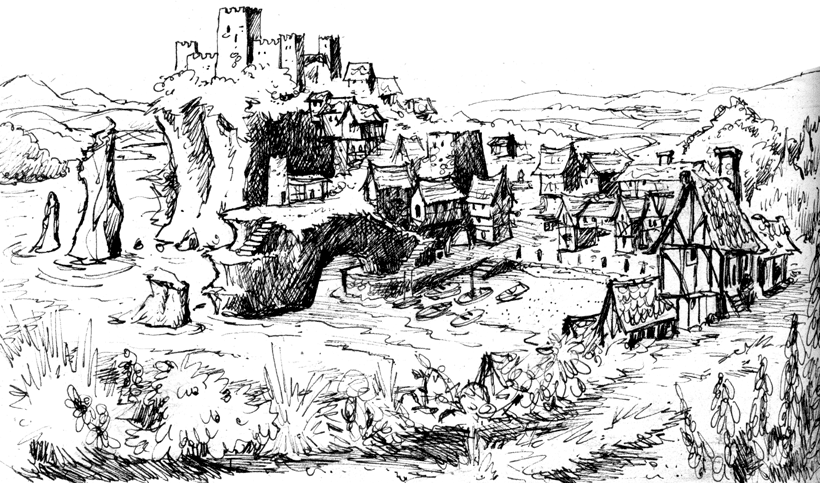
Those hills were gloomy and miserable, rising from ragged cliffs and rough seas, often surrounded by thick fog and coastal mists. It was under the cover of such a mist that Elendor III’s company managed to locate a secret underground entrance to the Head’s base, a previously abandoned castle. Thus, making their approach from below via forgotten caverns, Elendor III’s party eventually emerged into the dungeons of the Head’s fortress. There they discovered an awful truth - the Head was amassing an enormous army of demonic hell-spawn. Slowly he had been amassing these dark forces alongside growing numbers of disgruntled Kaotics from the brooding Scraper mountains, now assembling in and around the fortress. Orcs, Goblins, Kobolds, Ogres and all manner of other dastardly creatures were there, preparing to sweep the whole of Vordath and plunge it into an umpteenth darkness. This very confusion of different, chaotic armies, however, was exactly what allowed Elendor III’s band to penetrate right to the heart of the enemy’s stronghold, the gloomy keep that dominated his dark fortress. Yet it was no easy task. The tale was oft told later how, in the end, it came down to a one-on-one duel between wizard and warlord, as Elendor’s companions lay scattered around, at the edge of life. Of course, the esteemed sorcerer emerged victorious. The songs sing of how Elendor III then stood on the castle balcony and held aloft the Head’s head before punting it into the gathered crowd of evil, thus inventing the game of Blunderball. Once they saw their leader defeated and how powerful the wizard, all ten thousand Kaotics turned tail and fled... Or at least, that’s how the songs went when the aged Elendor III later had the bards play them to his great grand nephew Pewfell Porfingles, who knew better than to believe everything you hear in songs. One thing is for certain, Elendor III, tired of adventuring, took the Head’s great black castle for his own, re-naming it Cawdor Castle, after one in Prantem that he’d read a nice book about once. Prosperity soon returned and grew in the surrounding lands as news of the banishment of evil spread. The local people were mostly poor, living in small villages and farmsteads dotted between the murky forests and ancient hills, but a new spirit took hold as the last of the fiends were driven from the land with the help of the bold adventurers, all now revived and restored to health, save for the dwarf who had a real way of irritating the gods, and they finally claimed him. Cawdor Castle Along with the castle, Elendor III had also plundered the vast fortune amassed by the Head and, along with the great personal wealth he had built up over years of adventuring, he was now one of the wealthier lords in the whole of Midworld. Elendor III was a generous ruler, and did much to redistribute a reasonable chunk (but nowhere near all) of the Head’s horde to the people it had been plundered from, i.e. the serfs. But he continued to pay them well and hardly levied any taxes at all. Just enough to keep himself and his heirs in luxurious comfort for the rest of time. Trade opened up, and more and more ships sailed to Jonspont from the other ports of Midworld, in a time of increasing peace and prosperity. More traffic still sailed up the river to Spirekassle. The only real city in that area, Spirekassle, is approximately 150 miles north west of Jonspont and the South Vordath Coast. To its west are the Flintlock hills, and it is much too near the Scraper Mountains on the west for most truly civilized folk. Most of the truly civilized folk in Midworld lived in Prantem, the city of Paladins far to the south (almost 300 miles south of Spirekassle). Of course the inhabitants of Trader City at the heart of the Midworld Autocracy would claim that they lived in the only really civilized place in the whole world, but since very little was known of any other continent at that time, this is to be forgiven. After a long “will-they-won’t-they” courtship, that spanned many campaigns, Elendor III finally married his companion in arms and long time crush, Miranda the Mighty. Elendor III’s elder sister Elena, with whom he had never entirely lost touch, said this was only to be expected as they both had parents who were utter disasters as respectable role models. This caused an even greater great schism in the family, since Elendor regarded himself as one of the more respectable persons ever to have walked the face of the Urf. When Elena eventually passed on from old age she left a large family behind her, including a granddaughter named Glabella. Glabella was a bright, attractive girl of great curiosity, who had never been told much about her family history, other than her grandmother had often been known to curse the name of her degenerate brother. When pressed, Elena always refused to speak further on the subject and forbade her offspring ever to have any contact with her wayward brother. So, being a brave eighteen year-old when her grandma passed on, Glabella decided to set out in search of her long lost great uncle. She had many adventures of her own on the way, but eventually arrived safely at Elendor III’s castle. Miranda had died of old age some years before, and she and Elendor had remained childless. Thus Elendor III was never more delighted in his life than when he learned that an attractive young niece who wished to tend him in his failing years. Although, in fact, he was always a lot more healthy and vigorous than he ever let on. Well, it wasn’t long before Glabella met and fell in love with a young wizard named Preznaptix Porfingles. Preznaptix was not from a particularly well-to-do family, though his father had become a reasonably successful businessman in Spirekassle by anticipating the great curtain ring boom of 7139. The Porfingles family were from Old Spirekassle Village, and had lived in the region for countless generations. Family legend told of an ancient ancestor who had been chief druid of the region way back in the days of the Ferethian empire, though most people agreed that this was unlikely. Preznaptix was always a bit too eccentric for Elendor III’s taste, he reminded him too much of his father, Elendor II. Preznaptix, although fully qualified as a wizard, had never really gone much in for adventuring. He tended to focus more on research and was endlessly coming up with new spells and magical apparatuses. Most of these never seemed to work properly, or if they did, never proved to have much practical application or popular appeal. Still, Glabella appeared to be very much in love, so Elendor III gave them his blessing and supported their relationship with occasional injections of cash. Jonsport In return Elendor III insisted that their eldest offspring, a lad named Pewfell, be made his ward. Elendor III always regretted never having an heir and was determined to have someone he could train to follow in his footsteps. Pewfell was four years old when he went to live at the castle. He was the eldest of three children having both a sister, Clemilla (2) and brother, Alton - a mere babe in arms at that time. Pewfell had shown some certain aptitude for magic as a toddler, and Elendor III was determined to see him grow into a great and powerful sorcerer in the best of their family tradition, and not just go around blowing things up, like a lot of modern wizards tend to do. Old and ancient as he now was, and though he complained often and made himself out to be a miserable old sod, Elendor III was, deep-down, a fair and genial fellow. He grew more-and-more like a fat, old cat. He would enjoy a late fried breakfast followed by a long lie-in. Then he would leave a large and particularly smelly offering to Lurgi, before falling asleep again until supper, after which he would usually snooze in the bath, before being carried to bed by his grateful subjects. So it was that Pewfell had a privileged childhood, growing up in an enlightened, free and idyllic environment in the lands around the town of Jonspont, where education was esteemed above all things. Pewfell was a below average student in a small class of boys and girls from the castle and surrounding farms. For better-or-worse, the schooling was handled by a tutor, who made it his business to ensure that the great grand-nephew of his wizard lord, always scored well in his exams. The curriculum spanned the arts, science, history, religion and Urf studies. Elendor III himself insisted on instructing Pewfell in the art of Magic, although by degrees this daily afternoon evolved more and more into just an excuse for him to take a nap in the middle of the day, and as a result Pewfell’s education in the occult sciences was left sadly lacking. It was while growing up at Cawdor Castle that Pewfell first encountered Bish Bathenwell living in a hedgerow on his uncle’s estate. There had been a cat coming to the castle kitchen for scraps, and one morning Pewfell followed it, curious to discover it’s home. He saw it disappear into a nearby hedge, where he found it raising a litter of kittens and the naked form of a 6 ft 7 cleric. Or, at least, that was the story Pewfell told at the time. Bish seemed highly confused, knowing nothing but his own name. He was deemed an orphan and made a ward of the great cleric Hedges, brother of Benson. Although Bish was over 6 feet tall, he clearly had the mind of child, with a youthful complexion and soft, unsullied hands. Thus it was decided that he must have been around Pewfell’s age (at that time, 12 years old), and had perhaps been cursed with growth spell or some such magick. Anyway, the origins of Bish remained a mystery, but in those lands at that time strange mysteries were commonplace, particularly as concerned people’s parentage and it was considered polite not to delve too deep into such matters. Benson and Hedges had been companions of Elendor III in his many adventures; they were both orthodox priests of the great sun god Lug. It was Hedges who set up and tended a small temple dedicated to Lug in the grounds of Cawdor Castle. It seemed Bish had a natural aptitude towards religious studies, and (quiet unlike Pewfell) he showed a great deal of enthusiasm at the prospect of becoming an altar boy. So, once advertisements had been posted and it became apparent that there was no family forthcoming to claim the lad, the priest delightedly took him under his wing and began instructing him in the ways of his divinity, in the hope that Bish would one day take over the pastoral congregation of Cawdor Castle. It came as something of a shock to everyone when, on the eve of his initiation to the mysteries of Lug the good, Bish announced that he had received a vision from the goddess Hornbag. No one else could recall ever having heard of this particular deity, whose naked and fulsome female form had apparently revealed itself to Bish in a vision of light, not long after he had retired to bed one evening. A somewhat lowbrow vision, which Hedges might have attributed to the onset of puberty, had not Bish been so fervent in his newfound beliefs. Furthermore, along with his conversion, Bish had sworn an everlasting vow of chastity, saving himself until the day that he finally passed from the mortal world and came into the arms of the goddess herself. Hedges encouraged Bish’s Friendship with Pewfell, and Elendor III did also, both seeing the other as a good influence on their own ward. Shortly after this Pewfell, now 13 years old left for boarding school. A scraped pass of his Common Entrance scores, together with the high praise of his tutor and, of course, a generous donation from Elendor III were enough to get Pewfell into his guardian’s alma mater – the Stonestanding School of Sorcery in the city of Spirekassle. Bish remained at Cawdor castle, where Hedges continued Bish’s religious instruction as best he could. Although a keen and enthusiastic student, Bish was by no means a good learner. As he grew older, he became more and more distracted by visions of his goddess. Afraid that Bish’s self imposed vow of chastity might be doing his acolyte more harm than good, Hedges attempted to get Bish to take an interest in the opposite sex - the church of Lug does not forbid sexual relationships, and the priesthood is evenly distributed between men and women who frequently marry. Occasionally Hedges would leave copies of Playcleric magazine around, or arrange dates for Bish with young clerics from other churches. All to no avail, in fact it served only to intensify Bish’s fervor. By the age of 20 Bish realized that if he if he was to learn more about his mysterious patron deity he must leave his master and set out to seek his destiny. He was in the process of packing his bags when news arrived that Pewfell was returning from college—in disgrace. Pewfell had been expelled for vomiting over the examiner at his end of year finals. Although Pewfell claimed it was an unfair dismissal and not his fault, and later that he had simply “dropped out”, it was apparent to most everyone who was aware of his academic record that he wasn’t likely to have passed anyway. When asked what he planned to do with his life now, Pewfell announced his intention to remain at Cawdor Castle and perhaps become a herbalist, having at least scored reasonably well in his school thesis on the marjaweed plant. Elendor III said he would certainly not be funding this lifestyle. Pewfell’s mother had passed away some years before, and his father, though still alive and still living in a small cottage in Old Spirekassle village, had no funds to spare either. So when Bish suggested they answer an ad posted by the Jonspont town council, seeking adventurers to investigate what had happened to the keeper of a failing shipping beacon on a rocky spur of land, to the west of Jonspont. Pewfell reluctantly agreed... and thus begin the tales in this book. |
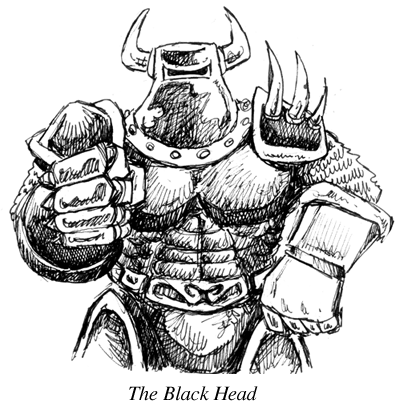 It was an uncle of Gerard’s who called on their assistance when the lands around his ancestral châteaux home, near the small town of Jonspont, fell under the sway of a dread tyrant known as the Black Head. The Black Head had marched out of the Scraper Mountains with a small band of followers and claimed the hills east of Jonspont as his own. At first, the locals were pleased, as these hills had always been a haven for brigands, raiding traffic on the Pelforth road and the Head brought some much-needed stability to the region. However, the Head was now extending his grip over an ever-wider area, demanding tariffs from the local farmers and tolls from all who passed through his land.